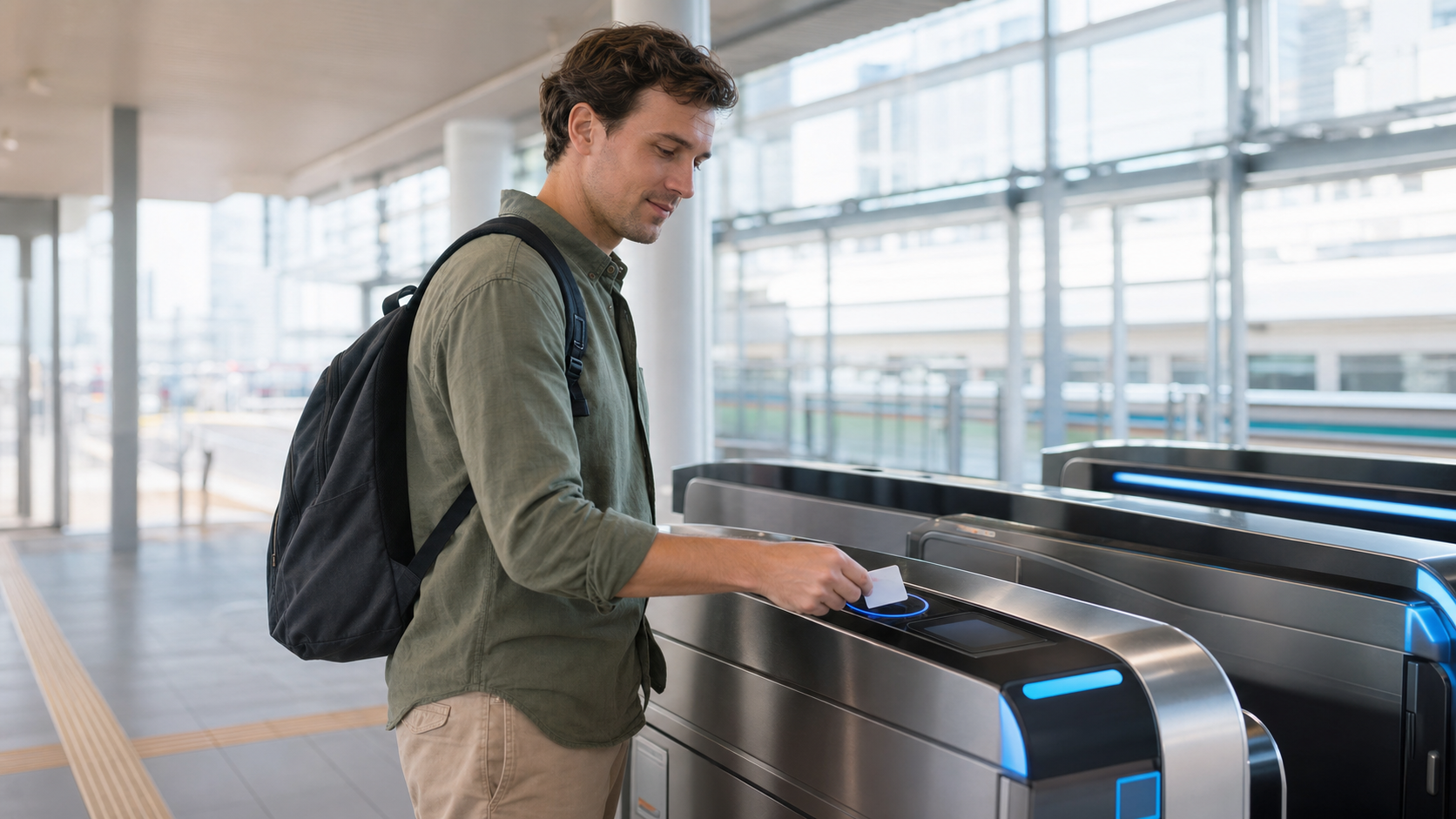
Japan’s IC cards make everyday travel much easier. Instead of buying a paper ticket for every ride, you can tap one card at a ticket gate, board most local trains and buses, and pay at many convenience stores, vending machines and station shops.
For most visitors, the names Suica, PASMO and ICOCA describe cards that work in almost the same way. The main difference is where they are issued—not where you can normally use them.
Quick answer: Buy whichever major IC card is easiest to obtain when you arrive. For ordinary travel, you usually do not need a different card for Tokyo, Kyoto and Osaka.
What Is an IC Card?
An IC card is a rechargeable contactless payment card. You add money to the card in advance, then touch it to a reader when entering and leaving a railway station. The system calculates the fare and deducts it from the balance.
The same card can also be used on many buses and for small purchases displaying the relevant IC payment symbol. This is especially useful when you are tired, carrying luggage or trying to board a train during a busy period. You do not need to study the ticket machine’s fare map before every short journey.
Suica, PASMO and ICOCA: What Is the Difference?
| Card | Main issuing region | Typical visitor use |
|---|---|---|
| Suica | JR East area, including Tokyo | Trains, buses and shopping in participating IC networks |
| PASMO | Private railways and subways around Tokyo | Very similar everyday coverage to Suica |
| ICOCA | JR West area, including Osaka and Kyoto | Very similar everyday coverage to Suica and PASMO |
Japan’s major transport IC cards are interoperable across a large national network. In practice, a Suica bought in Tokyo can usually be used on participating transport in Osaka, Kyoto and many other cities. Likewise, an ICOCA bought in Osaka can usually be used around Tokyo.
This means most short-term visitors should choose based on convenience. If the machine at your arrival station sells ICOCA, buying ICOCA is normally easier than searching for Suica. The logo on the card matters much less than having enough balance and knowing the few journeys that require a separate ticket.
Which IC Card Should You Choose?
Arriving in Tokyo
Suica or PASMO is the natural choice. Either works well for most ordinary train, subway and bus journeys in the Tokyo area. If a visitor version is available, read its validity and refund conditions before buying rather than assuming it works exactly like a standard card.
Arriving in Osaka or elsewhere in the JR West area
ICOCA is usually the simplest choice. It can be used on participating transport in Kansai and across compatible IC networks elsewhere in Japan. A standard physical ICOCA normally includes a ¥500 deposit, so the amount available for travel is lower than the total amount paid at purchase.
Visiting several cities
Keep using the same compatible card. You generally do not need to buy a new one simply because you travel from Tokyo to Kyoto or Osaka. However, IC interoperability does not mean every journey in Japan can be completed as one continuous tap-in/tap-out trip. Separate IC service areas and special trains can still require another ticket or a different procedure.
Physical Card or Mobile IC Card?
Physical card
- Simple to understand and easy to share among different phone ecosystems.
- Can usually be recharged with cash at compatible ticket machines.
- Does not depend on your phone’s battery.
- Each traveler needs their own card when passing through ticket gates.
Mobile card
Compatible Apple devices can support Japanese transit cards such as Suica, PASMO and ICOCA in Apple Wallet. Express Transit can allow you to tap without unlocking the device. Compatibility, supported payment cards and setup options vary by device and country, so complete the setup before relying on it for an important journey.
A mobile card is convenient because you can check the balance on your screen and may be able to add value without finding a cash recharge machine. A physical card is still a sensible choice if your phone is incompatible, you prefer cash, or you do not want transport access tied to one device.
Where to Buy an IC Card
Physical cards are commonly sold at participating railway ticket machines and service counters. Availability can change, particularly for limited visitor products, so check the issuing operator’s official information if you need a specific card.
- Find a ticket machine displaying the IC card name or logo.
- Choose English on the language screen.
- Select the option to purchase a new card.
- Choose the initial stored value.
- Pay using an accepted method and collect both the card and any change.
Keep the card somewhere easy to reach but separate from other contactless cards. If two cards are presented to the reader together, the gate may not know which one to charge.
How to Recharge Your IC Card
Recharge is often called charge in Japan. At a station machine, place or insert the card as shown, choose the amount, pay and wait for the machine to confirm the new balance. Many machines accept cash, and some have a tray rather than a card slot.
- Recharge before entering the gate if your balance is low.
- Keep some cash available because not every machine accepts foreign bank cards.
- Convenience stores can often add value to major IC cards; ask the cashier for an IC card charge.
- The maximum stored balance varies by product; standard ICOCA, for example, has a maximum stored value of ¥20,000.
A useful habit is to check the balance shown briefly on the gate display after each tap. Adding a few thousand yen at a time is usually more practical than loading a very large amount near the end of a trip.
How to Use an IC Card on Trains
- Confirm that your station and route accept your card.
- At the entrance gate, touch the card or phone flat against the illuminated reader.
- Wait for the confirmation sound and open gate.
- Keep the same card or device for the entire journey.
- At your destination, tap the same card at the exit gate.
Do not wave the card quickly above the reader. A deliberate touch for a moment is more reliable. If the gate closes, step aside instead of repeatedly pushing forward. Look at the small display for an error or ask station staff for help.
If you entered with a physical card, exit with that card—not a mobile version or another card from your wallet. The system needs to match the entry and exit records.
How to Use an IC Card on Buses
Bus procedures vary. Some buses require a tap when boarding and another when leaving. Others charge a flat fare and require only one tap. Watch what local passengers do, look for the IC reader, and follow the English signs when available.
If you are unsure, show the card to the driver before tapping. This is safer than assuming that every bus follows the same procedure.
Using IC Cards in Shops and Vending Machines
Major IC cards can be used for small purchases at many convenience stores, kiosks, lockers, restaurants and vending machines. Look for an IC payment logo near the register or card reader.
- Tell the cashier you want to pay by IC card, or select the IC option on the payment screen.
- Touch the card or phone to the reader.
- Wait for the confirmation sound before removing it.
This can be an efficient way to use a small remaining balance, but do not deliberately empty the card before your final train ride. It is useful to retain enough value for an unexpected transfer or airport journey.
Important Limitation: Shinkansen and Limited Express Trains
A normal stored-value IC card does not automatically replace every ticket. Shinkansen services, limited express trains and reserved seats may require a separate base fare, express ticket, seat reservation or advance linkage to a booking service.
If a train has a reserved seat number, a limited express name or a Shinkansen platform, do not assume that one ordinary IC tap covers the entire journey.
Check the operator’s instructions for that specific train. You may still tap an IC card as part of the process, but another ticket can be required.
Do Not Travel Across Separate IC Areas Without Checking
National interoperability allows the same card to be used in many regions, but it does not turn all participating areas into one continuous fare zone. A very long local-train journey may cross an IC area boundary that cannot be settled automatically at the destination.
For an intercity journey, check the route before tapping in. Buying a paper ticket may be easier, and Shinkansen is often the more practical option between major cities.
What to Do When the Ticket Gate Rejects Your Card
Low balance
Use a fare adjustment or recharge machine before trying the exit again. At smaller stations, ask an attendant.
Incomplete journey record
This can happen if you entered or exited through a staffed passage without the expected tap, or if a previous trip did not close correctly. Take the card to station staff and explain your previous origin and destination. Do not attempt to fix the record by tapping repeatedly.
Two cards detected
Remove the IC card from a wallet containing other contactless cards and tap it by itself.
Unsupported route or service
Some rural lines, highway buses and special services do not accept every IC card. Confirm acceptance before boarding when traveling outside major urban networks.
A Practical First-Day Routine
- Get one compatible card for each traveler.
- Add enough value for the first day, but avoid overloading it.
- Store it where it can be tapped separately from bank cards.
- Check the balance after leaving each station.
- Recharge before the morning rush or before entering a rural area.
- Keep cash as a backup.
This routine removes many small decisions from a travel day. The card will not plan the route for you, but it lets you focus on the platform, direction and destination rather than buying a new ticket for each ride.
Frequently Asked Questions
Can two people use one IC card?
Not for the same train journey. Each person needs a separate card because the system records an individual entry and exit.
Can I use Suica in Kyoto and Osaka?
Usually yes on participating IC transport and payment networks. Check the specific operator for rural routes or special services.
Can I use ICOCA in Tokyo?
Usually yes on participating services that accept the nationwide interoperable IC cards.
Can I recharge with a foreign credit card?
Do not rely on it. Physical-card recharge machines commonly accept cash, while mobile-card payment compatibility depends on the device, wallet and card issuer.
Should I refund the card before leaving Japan?
Refund conditions depend on the product and issuing operator. Some visitor cards have a fixed validity period and do not refund unused stored value. Standard cards may have deposit and fee rules. Check the current official terms before deciding.
Final Advice
Do not spend too much time choosing between Suica, PASMO and ICOCA. For most visitors, the best card is the compatible one available at the station where the trip begins.
Learn three habits: tap the same card at entry and exit, check the balance, and verify special or long-distance journeys before boarding. With those habits, an IC card becomes one of the simplest and most useful tools for traveling around Japan.