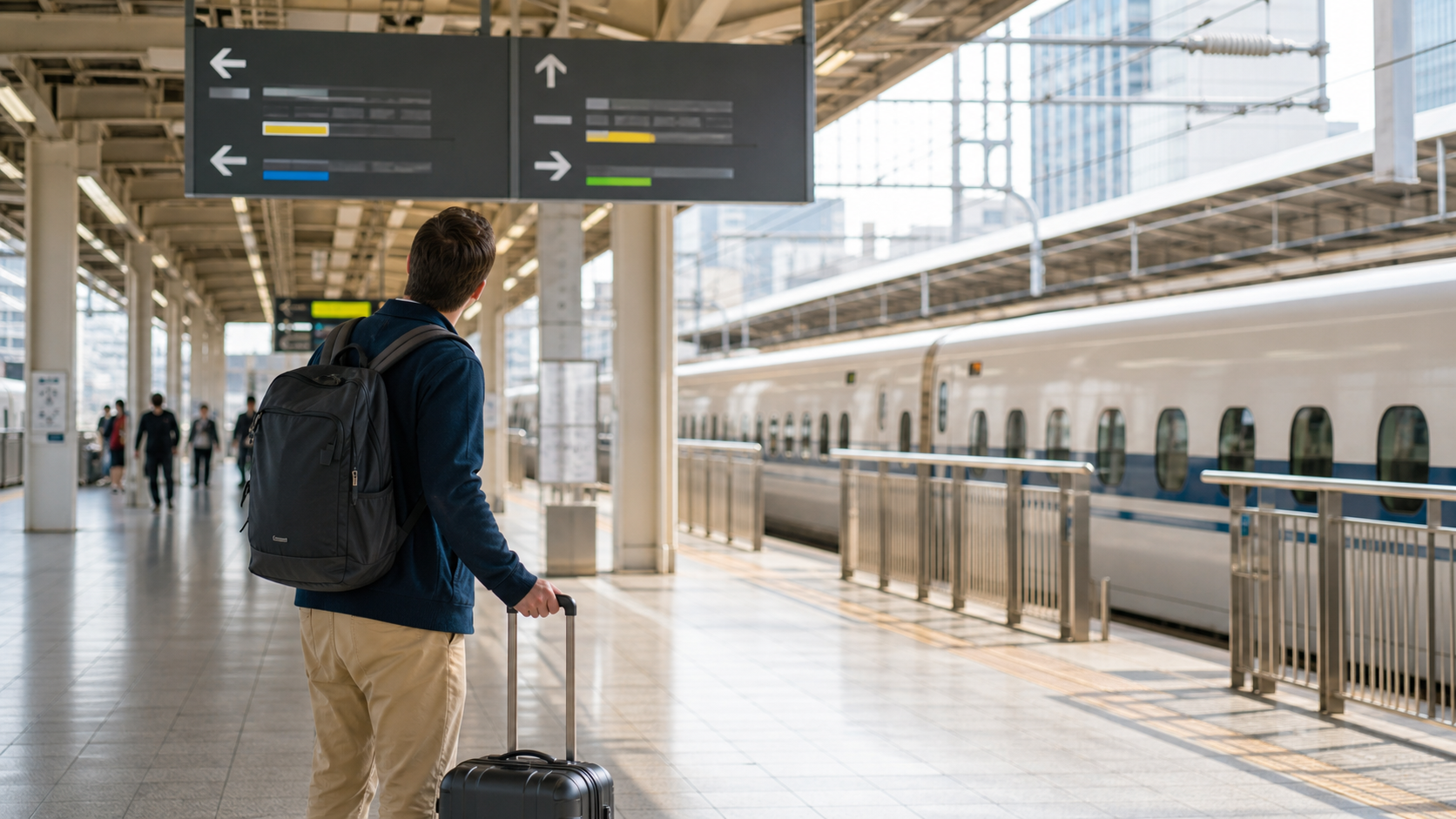
Japan’s railway system is clean, fast and reliable, but it can feel overwhelming on your first visit. Large stations may contain several railway companies, multiple ticket gates and platforms that seem to go in every direction.
The good news is that you do not need to understand the entire system before taking your first train. Once you know how to identify the correct operator, direction and platform, most journeys become surprisingly straightforward.
Quick Guide: Your First Train Ride in Japan
- Search for your destination in a navigation app.
- Check the railway company, line name and direction.
- Use an IC card or purchase a paper ticket.
- Enter through the correct ticket gate.
- Confirm the platform number and train type.
- Keep your ticket or IC card ready for the exit gate.
The most common first-time mistake is following only the line color. Several stations use similar colors, so always confirm the line name, destination and railway company as well.
Understanding Japan’s Train System
Japan does not have one single railway network. JR companies operate many major urban and intercity routes, while private railway companies and municipal subway systems operate their own lines.
In practice, this means two lines inside the same station complex may have different ticket gates. At a large station such as Tokyo, Shinjuku or Osaka, transferring between operators may involve leaving one gated area and entering another.
JR Lines
JR operates many familiar routes, including major commuter lines and most Shinkansen services. JR stations and entrances usually display the JR logo clearly.
Private Railways
Private railways are especially useful for reaching airports, suburbs and popular destinations. Depending on your route, a private railway may be faster or more convenient than JR.
Subways
Tokyo, Osaka, Kyoto and several other cities have subway systems. Some cities have more than one subway operator, so check the operator name when transferring.
Using an IC Card
For most local travel, a rechargeable IC card is the easiest payment method. Common cards include Suica, PASMO and ICOCA. Major IC cards are widely accepted across participating railway, subway and bus networks.
Touch the card to the reader when entering and again when leaving. The correct fare is normally deducted automatically.
- Keep the same card for both entry and exit.
- Do not place two IC cards on the reader at the same time.
- Check your balance before a long journey.
- Add money at a ticket machine when necessary.
- Ask station staff if the gate displays an error.
An IC card is convenient, but it is not automatically a ticket for every Shinkansen or limited express train. Some services require a separate ticket or reservation.
How to Buy a Paper Ticket
If you cannot use an IC card, purchase a ticket from a machine near the entrance. Many machines offer an English-language option.
On local routes, the fare may be displayed on a map above the machines. If you are unsure, use a route-search function on the machine or ask at the staffed counter.
Keep the ticket after entering the gate. You will normally need it again when leaving your destination station. The exit gate may collect the ticket.
Finding the Correct Platform
Before boarding, confirm four details:
- The railway company
- The line name
- The direction or destination
- The train type
The direction is often shown using major stations rather than north, south, east or west. For example, a sign may say that a train is “for Shinjuku and Ikebukuro.” Check whether one of the listed stations lies beyond your destination.
Platform displays usually show the departure time, destination, train type and number of cars. English information commonly alternates with Japanese on electronic displays.
Local, Rapid and Express Trains
Trains on the same line may stop at different stations. A local train generally stops at every station, while rapid and express services skip selected stops.
This causes many avoidable mistakes. A train can depart from the correct platform and still pass your destination without stopping. Before boarding, confirm that your station appears in the train’s stopping pattern.
If you are uncertain, taking a local train is often the simplest choice. It may be slower, but it reduces the chance of passing your stop.
Taking the Shinkansen
The Shinkansen is useful for longer journeys between major cities. Its ticketing system is different from an ordinary local train, so allow extra time on your first trip.
Depending on the journey, your ticket may include a basic fare component and a Shinkansen or limited-express component. You may receive more than one paper ticket. Insert the tickets together when instructed by the gate or ask station staff for assistance.
Reserved seats provide a specific car and seat number. Non-reserved seating, when available on the selected service, requires you to use the designated non-reserved cars. Service patterns and baggage rules can change, so check the railway operator’s official information before travelling.
Travelling with Luggage
Large suitcases are difficult to manage during rush hour and inside busy stations. Elevators may be located away from the most direct route, and transfers can take longer than a navigation app suggests.
- Allow extra time for transfers.
- Avoid blocking train doors and station passages.
- Use elevators instead of carrying heavy luggage on escalators.
- Keep small bags on your lap or on an overhead rack.
- Check current baggage-reservation rules before using the Shinkansen.
- Consider a luggage-delivery service when changing cities.
Rush Hour and Train Etiquette
Weekday commuter periods can be extremely busy, particularly in major cities. If your schedule is flexible, avoiding the busiest morning and evening periods makes travelling with luggage much easier.
- Wait in the marked boarding line.
- Let passengers leave before entering.
- Keep conversations and phone calls quiet.
- Set your phone to silent mode.
- Do not occupy an extra seat with luggage.
- Pay attention to priority-seat areas.
Common Mistakes to Avoid
- Entering the wrong company’s gate: Check the operator logo before tapping your IC card.
- Boarding an express train: Confirm that it stops at your destination.
- Following only the platform number: Platform assignments can change.
- Forgetting to keep a paper ticket: You may need it at the exit.
- Planning transfers too tightly: Large stations can require a long walk.
- Assuming every train accepts an IC card alone: Some services require an additional ticket.
What to Do If Something Goes Wrong
Do not panic if a ticket gate closes or displays an error. Move away from the gate so other passengers can pass, then show your ticket or IC card to station staff.
If you board the wrong train, get off at the next safe station and check your route again. Station staff are accustomed to helping visitors, and showing the destination name on your phone is often enough to explain where you need to go.
A Simple First-Trip Strategy
For your first journey, arrive at the station about 15 to 20 minutes earlier than the navigation app recommends. Confirm the operator and line before entering, then take a photograph or screenshot of the route details so you can check them without repeatedly searching.
Once you have completed one or two journeys, the system becomes much easier to understand. Focus on one trip at a time rather than trying to memorize the entire network.
Final Advice
Japan’s trains are one of the most convenient ways to explore the country. The system may look complicated at first, but clear signs, navigation apps and helpful station staff make it manageable for first-time visitors.
Always confirm current schedules, fares, service conditions and baggage rules with the relevant railway operator before travelling.